Expectations

A while ago, I drove through McDonald’s and ordered a large, unsweetened iced tea. As I drove away, I took a sip and immediately made a face. “Ugh! This is SWEET tea!” Not what I wanted, and not what I expected. I don’t have anything against sweet tea, I’m just not fond of sweet tea. So, I didn’t drink it. I just went back, let them know they got the order wrong, and got a new cup of unsweetened iced tea.

Sometimes, we don’t get what we want, or what we expect. That part may be out of our control. Once that happens, though, we are in complete control of what we do next.

Suppose that I made some orange juice, but when I looked for a container to store it in, all I could find were milk containers. So, I put the orange juice in the milk container.

Wait a minute — how do I know it’s a milk container? Was it a gallon jug that has “MILK” written on it? Was it a 1/2 gallon carton that says “MILK?” Or is it just that I make an assumption based on what I usually experience?  If the container is transparent, I should be able to see what’s inside, and I’ll know what to expect. But if it’s opaque, what’s inside won’t be immediately obvious.

So, let’s say that the container is opaque, it’s what I usually put milk in, and I put orange juice in it.

Now Joe comes home. He loves orange juice. He also likes milk. And he’s thirsty. So, he opens the fridge, reaches in and grabs the container, opens the top, and takes a big swallow. He’s likely to make a face. Why? Well, he expected milk, but he got orange juice. He might momentarily look up at me at say, incredulously, “What the hell?  This is orange juice! It’s supposed to be milk!”

At this point, he’s got some choices.

He can throw the container against the wall, swearing at me for putting orange juice in a milk container.

He can create a special area in the fridge for “queer milk” so that he never has to make that mistake again.

He can take a breath, and change his expectations, given the new information that he has in his hands. Now that he is aware that the contents of the container, he can decide that he’d like some more orange juice, or he can put it back into the fridge and look for something else, like the milk he expected in the first place.

He can stand there, demanding that the contents of the container magically become milk, to match his expectations of the container.

What can we learn from this?

Violence is never the answer. Swearing at me and throwing the container against the wall would waste some perfectly good orange juice and probably start a fight. And we all know that we shouldn’t cry over spilled… well, orange juice. In all fairness, it wasn’t the orange juice’s fault.

Designating a special area in the fridge? A waste of space if we rarely encounter “queer milk.” We may want to put some white wine in that spot at some point. It makes much more sense to allow queer milk to mingle equally with everything else in the fridge. Besides, There are some things that Joe could do to avoid confusion and become more comfortable when he encounters unexpected orange juice filled milk containers in his life.

For example, – maybe Joe shouldn’t drink directly from the container. If Joe had taken a few seconds to look into the container, he would have seen that the contents were orange, and not white. Had he poured some of the contents into a glass, he would have immediately seen that he had orange juice, and not milk. He then could have decided to drink the orange juice, or pour it back and choose something else.

In this case, he already tasted the orange juice. Once he realized it was orange juice, maybe he realized it was really good orange juice. That can really help get over the discomfort caused by the unmet expectation. If it was bad orange juice, he could just put it away and pick something else. So, maybe we should all get to know what’s in our glass before we take a sip.

Labels can be deceiving. If the container had a permanent “MILK” label on it, it can still be used to hold orange juice. We should always double check before making an assumption.

Communication is important. When Joe went to the fridge to get a drink, I could have said, “hey, by the way, I put orange juice in the milk container. So, don’t expect milk.” That would have set his expectations and helped him make an informed choice.

Finally — and this one is really important — Getting upset about the fact that orange juice is in a container you expected milk to be in doesn’t mean that the orange juice will change to meet your expectations. It’s still going to be orange juice. Sure, you can go through the rest of your life calling orange juice in milk containers “milk,” but you’re really only fooling yourself. You can only control your next choice. And really, who cares which shelf I put it on in the fridge? It’s still got to get cold.
 

An Open Letter to… Well, Just About Everyone

Trump is in the news again. That’s not surprising, as he’s running for President and has a penchant for making outrageous comments that end up creating great divides between people across the country.

** Warning – this video contains vulgarity **

https://www.youtube.com/watch?v=8wM248Wo54U

In this case, the video is more than ten years old, and contains a conversation that took place off camera with Billy Bush, as they were on their way to some sort of filming. There is much to be offended by in this video, which is certainly being leveraged to damage Donald Trump’s run for President. What I see and hear in the video are two men talking vulgarly about a woman that Trump attempted to seduce, unsuccessfully. Donald is heard bragging about what his celebrity “allows” him to get away with. Billy Bush seems to be enjoying the conversation, as he is encouraging and, in fact, cheering Donald on. Once they exit the bus, Donald puts on his “professional” persona while Billy Bush takes on the role of “wing man,” suggesting that the woman in the video give hugs to Donald, and then himself, and continues to make sexually charged comments as they walk down the hall.

Because Billy is not running for President, his behavior is not in question by the media. In general, the media has wholeheartedly condemned Trump’s comments, while many Trump supporters have come out in defense of Trump to condemn the release of a private conversation, and others have dismissed the comments as “standard locker room talk.” I have seen some comments suggesting that most men engage in this type of banter.

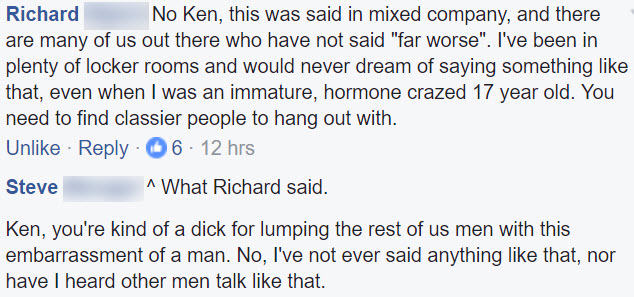
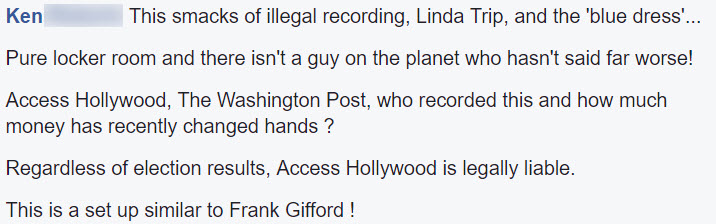
Ken 1This is what I want to talk about.

This is my “open letter” to just about everyone. Originally, I was going to write this to women, and then I realized that I was leaving out a critical part of the conversation. The subject is not Donald Trump and whether or not he should become President after making these comments. The subject is “Rape Culture and Why It Exists.”

I hope you shuddered and felt really uncomfortable when you read that. Rape is a terrible word. Over the years its impact has been diminished by slang phrases that made the term more commonplace. In my opinion, the word “rape” should have the same impact as the word “fuck.” It should be used rarely, and make people sit up and pay attention when they hear it.

Rape is a violent crime. It’s not just sex. A rapist violates his/her victim in the most intimate of ways, leaving them exposed and vulnerable. We are taught that rape has nothing to do with sex and everything to do with power and violence. And yet, the average sentence for a rapist is just under 10 years, and most serve just under 5.5 years (Bureau of Justice Statistics). We have all read recently about the case of Brock Turner, who, after being convicted of three counts of sexual assault, was sentenced to six months in prison and served only three. Even after his conviction, media sources continued to refer to him as the “Stanford swimmer,” as though his athleticism was more important than the crime he committed.

With modern technology, we are bombarded with messages via television, radio, and social media. What this media seems to be telling us is that women need to take steps to prevent rape. We need to dress modestly to avoid being seen as sexual objects. We need to make sure that we remain indoors in a safe environment when it is dark out, and not walk around alone outside. We need to make sure that we say “NO” in a very clear manner that is understood, and even then, we are not trusted to actually mean it. We should be very careful what we drink, in case someone has put a date rape drug in it. One judge in Canada even asked the rape victim why she couldn’t just keep her knees together.”

Let’s be clear. Rape is never the victim’s fault. It is always the perpetrator’s fault. And while it is smart to take steps to avoid being a victim, each and every one of us should be offended that there is even a need. Women do not have the same freedoms as men. We must constantly be on the lookout to ensure that we are safe. We may have a woman running for the highest office in the land, but we will never achieve true equality until we can walk in the same spaces as men and feel every bit as safe as they do.

So here’s the deal. When you hear Donald Trump and Billy Bush bantering and laughing about their sexual conquests, scoring, and being allowed to grab women anywhere, you cannot dismiss it as “standard locker room talk.” If you do, you’re suggesting that it is okay. You are suggesting it is okay to treat women as though they are objects, to be used and thrown away. You are suggesting that it is normal and acceptable behavior to speak of women in a disrespectful manner. All of this adds to the problem. When it is normal and okay to talk that way, it becomes normal and okay to view women that way. Then, it becomes the woman’s fault for “looking hot,” and responding to someone who seems to be treating her well, until he’s not treating her well anymore, and ends up taking what he wants and throwing her away.

Richard 2

When you hear your friends talking this way, do you stop them? Or do you laugh and join in?

Mitchell

If you have a brother, a sister, mother, father, son, daughter, friend – anyone – who tweets or posts or speaks to defend this behavior as “standard locker room talk,” or suggests that “there is no man who hasn’t said or done the same,” I urge you to sit that person down and have a talk. Tell them it isn’t okay. Tell them they are contributing, however subtly, to rape culture. Tell them that things need to change, and that they need to help lead that change in their own lives, by influencing their friends, and their families, and maybe even themselves. When it becomes “not okay” to speak of and treat women as objects, then perhaps we’ll all feel more horrified when women are treated poorly, or attacked, or raped. And maybe we’ll actually consider punishing those who attack them more than we punish those who possess drugs (in Kentucky, a first offender for drug possession can be sentenced to 2 to 10 years and fined $20K).

The video, below, features Steve Connell, who shares “Violence against women needs to end where it begins… at the hands, in the hearts and in the minds of men.”

https://youtu.be/PscD6h1iNiI

We have to change this together. It shouldn’t be up to the women to prevent their own rape. It should be up to a society who values women, cherishes women, and respects women, to collectively ensure our safety. Walking about freely should be a given, not a privilege afforded only to the big, strong, and armed.

Poet and justice advocate FreeQuency says it all quite well in her poem, “I’m Sorry.” In it, she quotes several members of Congress who have, in the past, spoken lightly about rape.

I implore each and every one of you to do your part to make this world a better place, a safer place, for women and children. We’re all on this earth together.


This is my body

I saw a video this morning that made me cry.

Jennifer in WA childhoodWomen of all ages, colors, sizes, and shapes were being asked to describe their bodies.
I kept hearing the words, “Imperfect,” and “Disgusting,” and each time, I was shocked.
Disgusting?
These women weren’t sitting in filth. They didn’t appear to be unwashed and odorous.
Disgusting?

It seems that, to many women, “imperfect” is equal to “disgusting.”

If that’s the case, then I’ve always been disgusting.

Even in my mother’s womb, my body was imperfect.
I emerged into this world with ‘some assembly required.’
I’m pretty certain that my parents didn’t think I was perfect.
But, I’m 100% certain they didn’t think I was “disgusting.”
I believe they found me beautiful, and full of hope and potential.

Still, I did quickly learn the ways of body shaming.
Perhaps not in the usual way, finding soft parts, and flabby parts, and parts that aren’t quite shaped the way everyone draws them or edits them in photographs.
In fact, as a teen, I was gloriously thin, and I have the photos to prove it.
But I had scars, and a leg that bent kinda funny.

I found that people stared, and some became uncomfortable, and some even shouted out words to label me, attempting to describe and become more comfortable with something they didn’t understand.

And so I learned to cover them up.
But I didn’t think my body was “disgusting.”

When I wore a swimsuit, there was never a bikini. Why not? Because of the smallest pooch in my stomach. I was self-conscious. My stomach was not perfectly flat, as I perceived it should be.

Still, I never thought my body was “disgusting.”

I met a man who thought I was perfect, and beautiful. I married him, and we had two perfect children together. He still tells me I’m beautiful (even if he’s figured out that I’m not perfect).

He would be horrified at the thought that my body was “disgusting.”

Years later I realized that once I moved to a new community, I had stopped wearing shorts and swimsuits altogether. To do so would expose the scars and lead to questions. Under the cover of clothes, I could be perceived as “normal.” Once I realized this, I took a leap of faith and exposed the skin, the scars, and the imperfections, and yes, there were questions. I provided answers, and I was still loved and accepted.

Jennifer 50

Over the years, my body has become soft, and overweight. I sag in places that I’d rather not sag. Sometimes I look in the mirror and wonder if people ever think I’m pregnant, because that little pooch in my stomach is not so little anymore. I’m more “solid” than “petite” nowadays, and I could stand to lose more than a few pounds.

I recognize all of this, and yet, my body is not “disgusting.”

My greatest challenge is not with comparing myself to the images in the media, whether photoshopped, or weight contracted, or covered in make-up. I know about those. My greatest challenge is with comparing my current self with my younger self. Hindsight (pun intended) is 20-20, and now I can say with complete honesty that I was always beautiful. I should have worn bikinis and shorts. It’s easy to look back and point to a time when I can see that I was at my prime. The trick is to remind myself that I am still “prime.”

Jennifer Dancing

My body has been taken apart, and put back together again – more than once. It has run, and jumped, and swum, and hiked. It has kissed, made love, and borne children that it was never supposed to be able to carry. It has skied, and hugged, and nursed, and comforted. It has sewed, crocheted, danced, sung, cooked, eaten (and eaten some more), gardened, driven, and been massaged. It has grown, and shrunk again and again, and it has been loved.

This is MY body. It’s not perfect – never has been, and never will be. But it’s mine, and it houses everything that I am. It reflects the experiences of my life. I love my body, because I love myself, even if I frown at it in the mirror, knowing that I could do more – and I will, when I’m good and ready. For me, not for a society that doesn’t want to see my scars or my fat.

God does not give you a body and a contract that requires you to return it in the same condition you received it. God gives you a body and says, “Use it. When you’re finished with it, I’ll recycle it.”

Starbucks’ Red Holiday Cup

I can’t believe that people are taking offense at what Starbucks didn’t do. They didn’t put snowflakes, and ornaments, and a tree on their red holiday cup. The offense? Apparently, this is part of a “war on Christmas.” Seriously? Since when does Starbucks, or any company, owe us holiday recognition? Since when does the general public get to dictate how a company chooses to acknowledge (or not) any of our religious holidays?

Why aren’t people upset that the cups aren’t blue and white, in honor of the upcoming Hanukkah celebration?

If you call yourself a Christian, and this is what is upsetting you, I think it’s time to go back and have a long chat with God. You’re missing the entire point.

If you’re Christian, then Christmas is a time of joy, of anticipation, waiting for the birth of the Savior. It’s about giving — the Savior came with the sole purpose of giving his life for yours, for ours. Most of us won’t give our lives, but this is a time when we should be thinking about ways that we can give of ourselves to others. Thus, the entire point of gift-giving. But, how many of us give beyond our own family and friends? What are you doing to be like the Savior this year? Are you giving food, clothing, or shelter to the homeless? Are you donating to help Veterans? Are you building homes for the poor? Are you helping pay for medicine for people who can’t afford it? Are you helping to relocate refugees? Are you looking around your own neighborhood and providing companionship to an elderly person who may be alone?

Stop worrying about what Starbucks isn’t doing. Smile, and be a Savior to someone else.

tvesq

Work in Progress

I am definitely a “work in progress.”

When I was married nearly 30 years ago, I weighed 98 lbs. @ just under 5′ tall. Today I’m 50 lbs. heavier, and struggling with the self-image that is prompted by the way that society views and values women. I have good days, and bad days with that self-image.

This morning, I had to turn off the radio in order to help promote a good day for myself. I was listening to the Mark in the Morning show on 100.3 The Sound (Los Angeles), and they were doing something that seemed kind of fun – showcasing a saxophone player. But then, a girl walked in, and the “man on the street” said, “Hey, a pretty girl just walked in. Do you want to talk to her?” Mark responded, “Is she really that good looking?” Answer: “She’s do-able.” This is where I tuned out.

We live in a world where our value as women is measured by whether or not we’re “do-able.” Even on the radio, where people can’t see what she looks like, this woman was presented as a product and judged by one person with a microphone. Maybe, instead, they could have stuck with the saxophone player and decided to speak with her based on whether or not she seemed to be enjoying the music.

I’m proud of the women in Hollywood who are fighting back against the empty questions about “who” they are wearing, what they look for in a man, and how they balance being a mother and a career woman. These are not questions that are asked of men. I avoid television shows that are designed to tear women down by critiquing what they wear and how they do their hair and makeup, and that focus on pitting women against each other in petty cat fights. This generally means that I don’t watch most of reality TV.

I read a story on Facebook a while back about a woman whose children posted a photo of her in a swimsuit at the beach. She was mortified, because all she saw were flaws and fat. She asked her children to take down the photo, and they were surprised. Because they saw their beautiful mother. They saw the happy, relaxed look on her face. They saw the angel that was their mother in an idyllic situation. They didn’t see what she saw.

So, I’m a work in progress. This doesn’t mean I’m going to ignore my weight. It’s important to be healthy. But I doubt that I’m going to see 98 lbs. again. I’m probably always going to be a bit square, whether I’m all muscle, or whether I’m soft. I’m short, and my awesomeness must work within the frame that I’ve been given. It’s time for me to stop worrying about how other people see me. Frankly, I love WHO I AM much more than I like HOW I LOOK.

In the meantime, I encourage everyone to change the channel, unsubscribe to the magazines, and stay away from the toxic messages that tell women that we are only worth our sex appeal.

How to Block App Invitations on Facebook

Do you have friends who play games via Facebook apps? You know you do if you frequently receive invitations to play those games.

Often, these friends have no idea that the game is sending invitations on their behalf. It’s just part of the “service” the game provides when you sign up for it through Facebook. But, did you know that you can block these invitations without having to block your friend?

Here’s how:

  • Start by clicking the Padlock icon at the top left corner of your screen.
  • Then, click the See More Settings link.

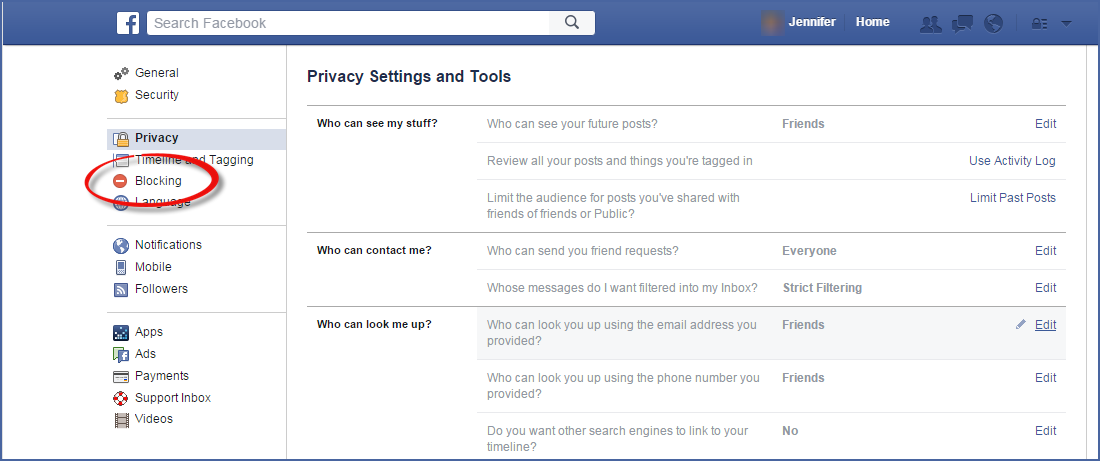
  • That will bring up the Privacy Settings and Tools screen. From here, you want to click the Blocking option at the left side of the screen.

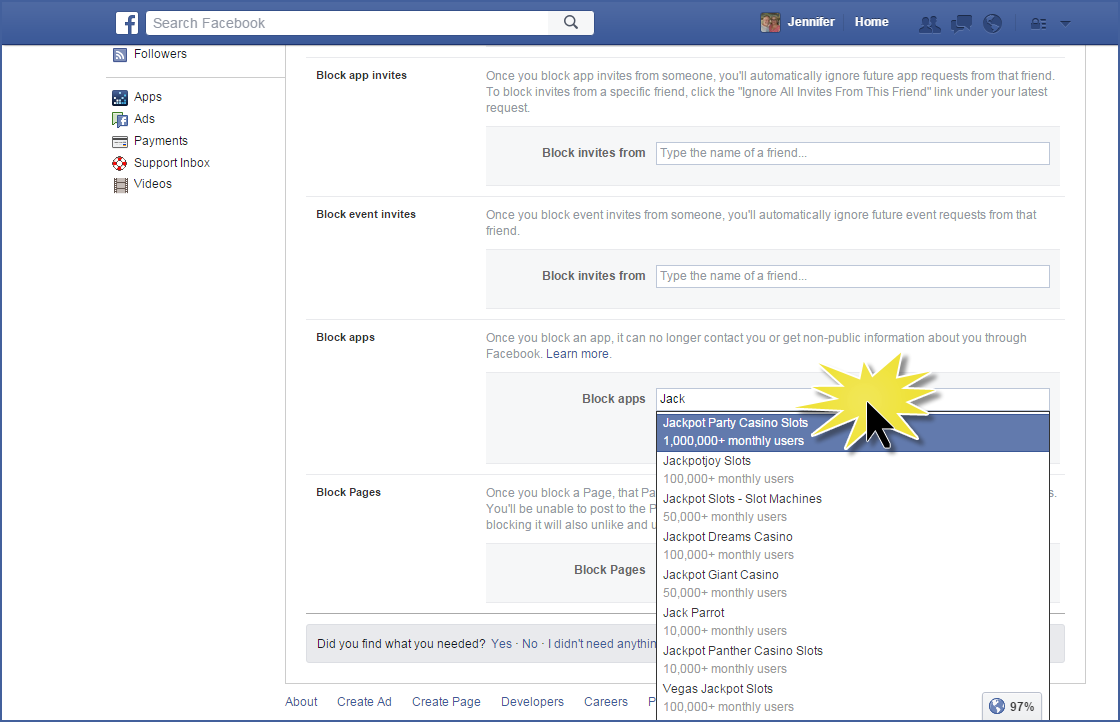
  • Now you’ll see the Manage Blocking screen. Scroll down the window until you can see the Block Apps section.
  • Click in the Block apps box and begin typing the name of the app or game.
    In my case, my friend invited me to play Jackpot Party Casino Slots. So, I started typing, and the name popped up.
  • Click to select the name from the list.

Blocking Settings

That will add the app to the block list. You should not receive any more invitations from this app, even if your friend sends them.

There is no Save option on this screen. So, once you see the app on the block list, just click your Home button at the top to continue your Facebook browsing!

Finished App Block

I’ll Be With You Shortly

(Photo by Jason Ortego)

“I’ll be with you shortly,” said the young man at the auto repair shop. He was tall, young, and handsome, and I was sure he was just trying to be helpful. “Thanks,” I replied, “but there’s no need to be insulting!”

At 4’12”, I’ve always been sensitive about my height. Even as a child I was short… er…”staturely deficient.” The strange thing is that people who are tall or “staturely endowed,” always seem to think that perhaps I am not aware of it. “Gee, you’re short!” is often the first observation people share with me. Usually I manage to swallow my initial response (“Duh!”), and opt for the more polite, “Really? I never noticed.”

I once met a man who was exceptionally tall, probably close to 7 feet in height. We met in the cafeteria at the university I was attending and ended up standing in line next to each other. At one point, he looked down at me and said, “Oh, Hi! Gee, I’ve never seen you around here before.” Looking way up and hoping to avoid neck strain, I just smiled and replied dryly, “I wonder why?” I’m not even sure he heard me.

Tall people don’t realize what a difficult world this is for short people. Practically nothing is built with short people in mind. Deli counters at the grocery store, for example. I can ring the bell, wait a few minutes, and the person at the counter thinks that some kid is playing “ding dong ditch” with them. Usually I have to stand on my toes, jump up and down with my arms in the air and holler a bit to get their attention. “Hey! I’m down here.” I try to shop when the counters are likely to be less busy. Otherwise, unless I am feeling really assertive, I end up getting my turn after all of the tall people are finished.

Continue reading →